
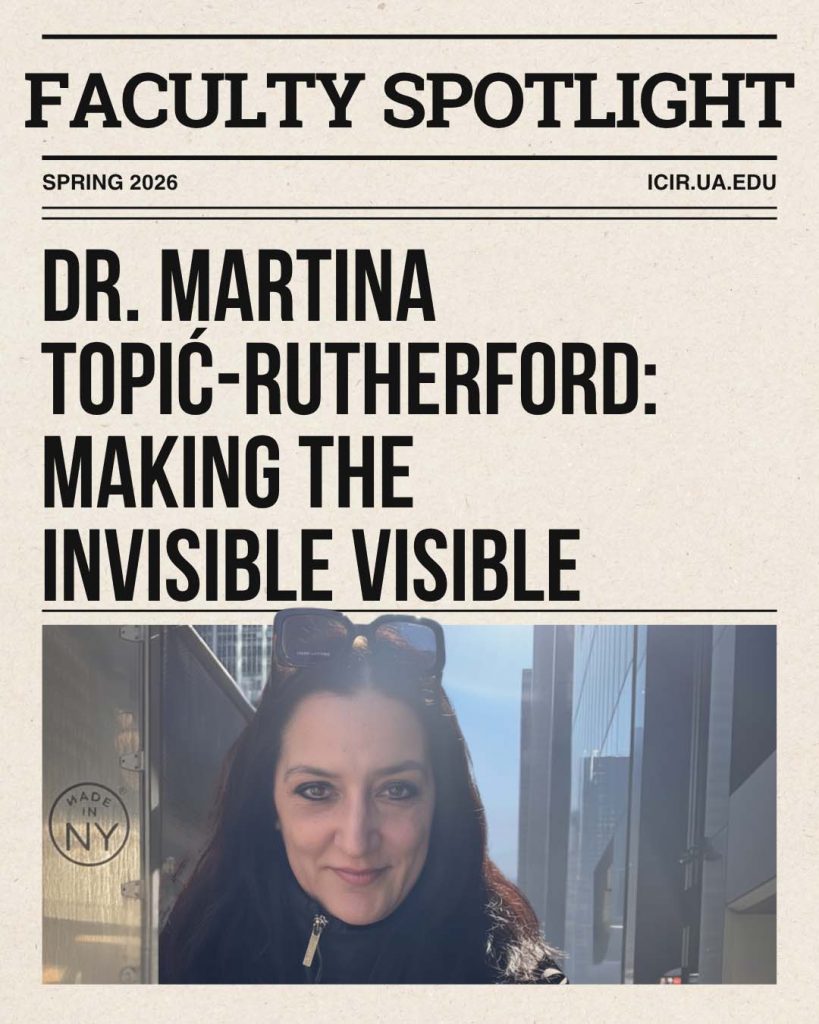
Dr. Martina Topić-Rutherford, associate professor in the Department of Advertising and Public Relations, examines how communication shapes leadership and cultural meaning. Drawing from behavioral sociology and media studies, her work explores how authority and belonging are not simply declared but are constructed through everyday interactions.
The Construction of Credibility
At the center of Topić-Rutherford’s research is a key question: how is legitimacy produced, maintained, and sometimes misrecognized within organizations? Rather than focusing only on what is communicated, she studies how meaning is created through what is said, left unsaid, and normalized in professional environments.
“Legitimacy isn’t just stated,” Dr. Topić-Rutherford explains. “It’s produced, recognized and sometimes misrecognized through everyday communication.”
Her research is deeply rooted in lived experience. Early in her career, she became interested in workplace dynamics after recognizing patterns in how certain behaviors were rewarded in media and communication industries. That curiosity led her to study cultural and symbolic capital, examining how unspoken norms shape who is seen as credible, capable or worthy of leadership.
By focusing on these underlying systems, her work reveals how organizations often reproduce inequality not through explicit policies, but through informal practices that influence recognition and belonging.
Why This Work Matters Right Now
Topić-Rutherford’s current work reflects a balance between academic research and real-world application. She recently had a book published titled “Fashion Advertising and Public Relations: A Historical and Sociological Perspective,” and is working on a forthcoming book focused on developing a communication model for fashion communication. In addition, she has ongoing research examining workplace culture, leadership and professional recognition in communication industries.
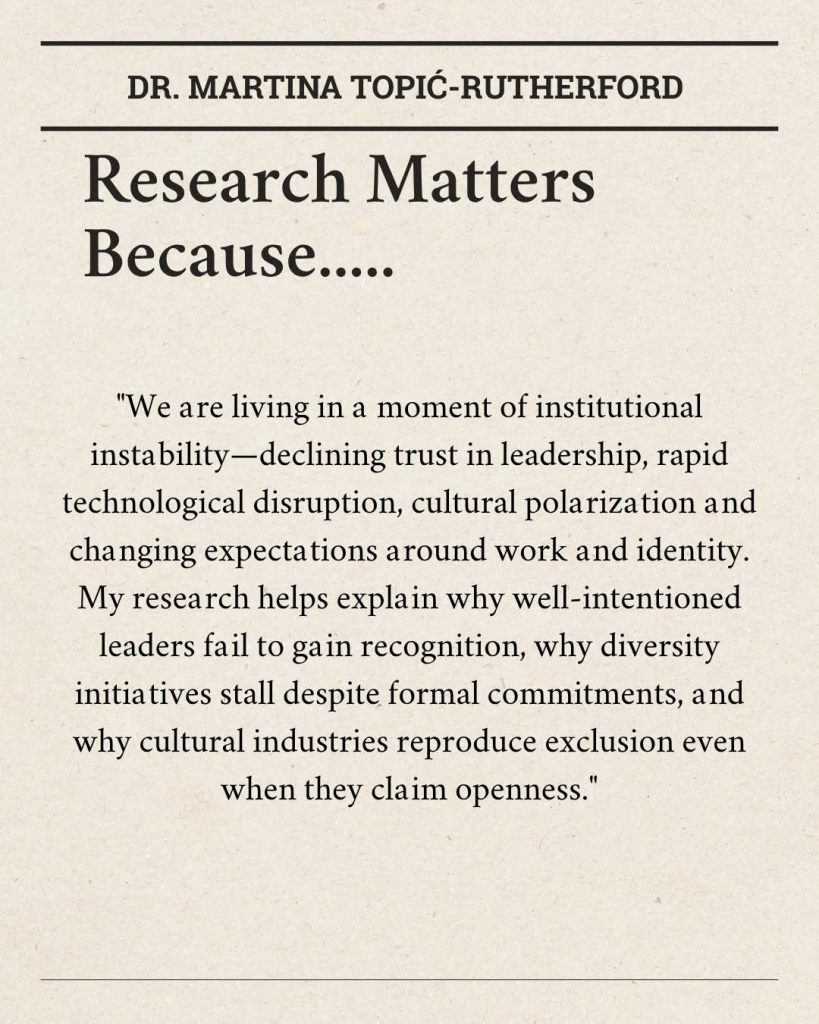
Her work is especially relevant in today’s climate of institutional uncertainty, where trust in leadership, workplace expectations and cultural norms are rapidly shifting. By applying sociological theory to communication practices, she provides insight into why organizations struggle with issues like leadership credibility, diversity initiatives and employee engagement.
“Research matters because it makes the invisible visible,” Topić-Rutherford says. “It gives language to patterns people experience but cannot always articulate.”
Beyond academia, her research informs leadership development, workplace culture strategies and organizational analysis. It offers practical tools for understanding how power, recognition and belonging operates beneath the surface of everyday communication.
Through her work, Topić-Rutherford continues to challenge how we think about communication, showing that it is not just about messaging, but about shaping the structures that define who belongs and who leads.