
Dr. Abdullah Salehuddin, assistant professor in the Department of Communication Studies, centers his research on how communication and relationships shape the ways people navigate stress, both within families and in higher education. His work spans two primary areas: communal coping in close relationships and the structural and interpersonal barriers students face in academic settings. Together, these areas are connected by a central question: how past experiences and unequal access to resources shape the ways people navigate both relationships and institutions.
The Personal Drive Behind the Research
For Salehuddin, research is a tool for systemic change. His background as a scholar is deeply tied to his own experiences navigating academic systems, which drives his focus on the structural and interpersonal barriers students face.
“Having encountered significant challenges during my own educational journey, I now seek to identify the obstacles students face and to contribute scholarship that can help make academic and economic upward mobility more attainable,” Salehuddin says.
This line of research focuses on challenges such as homelessness and the impostor phenomenon, or the persistent doubt about one’s success, and how these affect a student’s academic success, identity and sense of belonging. His work highlights how individuals make sense of these experiences to persist within systems that are not always designed with their backgrounds in mind. This work will be recognized at the 2026 International Communication Association conference, where his study on how first-generation graduate students manage uncertainty was named a Top Paper in the Instructional and Developmental Communication division.
Navigating Caregiving and Family History
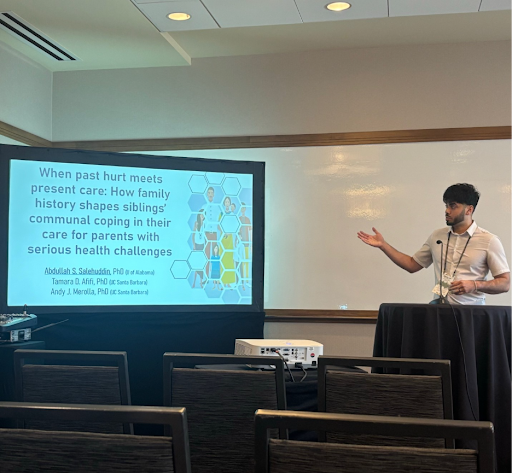
Salehuddin’s also explores concepts such as communal coping, the process where individuals treat a stressor not as “individual” but as “shared,” pooling their resources to manage it together. His current research examines how adult children care for an ill parent while navigating complex family dynamics.
A recent study identified four distinct caregiver profiles, demonstrating how both childhood experiences and present conditions shape how individuals engage in caregiving.
“While an unexpected medical diagnosis may be beyond our control, the choice to engage in communal coping with family members, including those who may have hurt us in the past, remains within our agency,” Salehuddin notes.
Salehuddin’s findings show that unresolved family dynamics can complicate caregiving, particularly when sibling relationships are strained. This research offers practical recommendations for professionals, emphasizing the importance of tailored, trauma-informed support that reflects each family’s unique history.
A key takeaway from his work is that while some life challenges may be beyond individual control, the ways people choose to engage with others in response to those challenges remain within their agency. Salehuddin’s research highlights how communication can shape not only relationships, but also the possibilities for support, resilience and connection across different life experiences.